How Google Decides Who Ranks #1 — And What Every Local Business Can Do About It
Posted on
SEO
Posted at

Author
Daria Nikolaeva
Table of Contents
Google uses over 200 signals to rank websites. Here's what they mean for your shop, salon, plumbing company, or restaurant — and exactly how to use them to outrank your competitors.
Every day, your potential customers type something into Google — "best pizza near me," "emergency plumber Austin TX," "hair salon open Saturday" — and within a fraction of a second, Google decides whose website appears at the top and whose gets buried on page two, where, as the old SEO joke goes, you might as well not exist. If you own a local business, that decision matters more than almost any other marketing variable in your business. And yet most local shop owners, service providers, and small businesses have little idea how Google actually makes that call.
Here's the truth: Google uses over 200 ranking factors — some confirmed, some researched, and some still debated — to decide which businesses earn those top spots. The good news is that you don't need to master all 200. You need to understand the ones that matter most for local businesses like yours, and then consistently execute on them. That's exactly what this guide will show you.
200+ Google Ranking Signals
95% Clicks go to page 1 results
8.5B Daily Google searches
What Are Google Ranking Factors, Really?
A Google ranking factor is any signal that helps Google determine whether your webpage deserves to appear at the top of search results for a given query. Think of Google's algorithm as an incredibly sophisticated judge. When someone searches "best Italian restaurant downtown [city]," Google needs to evaluate every relevant webpage on the internet — in milliseconds — and decide which one best answers that person's question.
To make that decision, Google looks at signals from three broad areas: your content (is your page relevant and genuinely helpful?), your authority (do other reputable websites trust and link to you?), and your experience (is your website fast, secure, and easy to use on a phone?). These three pillars sit at the center of every local business SEO strategy worth its salt.
What makes this more nuanced — and more interesting — is that Google doesn't apply the same weight to every factor for every search. If someone searches for breaking news, freshness matters most. If someone searches for a dentist, trust signals and reviews dominate. If someone is hunting for a plumber at 11pm, proximity and availability become critical. The algorithm is dynamic, contextual, and constantly evolving. But the fundamentals below are the ones that have proven, year after year, to move the needle for local businesses.
"Google's goal has never changed: show the person searching the most relevant, trustworthy, and useful result as fast as possible. When you optimize for that goal, you optimize for Google."
The 8 Ranking Factors That Matter Most for Local Businesses
Out of 200+ signals, these are the eight areas where local businesses will see the greatest return on their time and investment. Master these, and you will outrank most of your local competitors — because most of them are not doing this work.
High-Quality, Helpful Content
Content that genuinely answers your customer's questions is the single most important factor. Google's "Helpful Content" system actively rewards pages written for people, not for search engines. For a local plumber, this might mean a detailed page explaining what to do during a burst pipe emergency. For a salon, it might be an honest guide to choosing the right hair treatment for your hair type.
Backlinks from Reputable Sources
When other trusted websites link to yours, Google treats it as a vote of confidence. A local news article mentioning your restaurant, a mention from the Chamber of Commerce website, or a blog post on a popular local lifestyle site all count. Quality matters far more than quantity — one link from a respected local publication beats 50 links from random low-quality websites.
Google Business Profile Optimization
For local businesses specifically, your Google Business Profile (formerly Google My Business) is one of the most powerful ranking tools available — and it's completely free. A fully completed, regularly updated GBP with photos, hours, services, and consistent NAP (Name, Address, Phone) information dramatically boosts your visibility in local map results and "near me" searches.
Online Reviews and Ratings
Google actively factors in the volume, recency, and quality of your reviews. A plumbing company with 150 Google reviews averaging 4.7 stars will consistently outrank a competitor with 12 reviews averaging 3.9 stars. Reviews are social proof for both Google and your potential customers. Developing a consistent system for requesting reviews after every job is one of the highest-ROI activities a local business can do.
Mobile-Friendliness and Page Speed
More than 60% of local searches happen on mobile devices. If your website is difficult to use on a phone — tiny text, buttons too close together, slow loading times — Google will rank you lower. Google uses mobile-first indexing, meaning it evaluates the mobile version of your site, not the desktop version, as its primary benchmark.
E-E-A-T Signals
Experience, Expertise, Authoritativeness, and Trustworthiness. Google evaluates whether your business and your content demonstrate real-world experience and credibility. For a local HVAC company, this means having pages that showcase your certifications, team experience, and years in business. For a medical clinic, it means having licensed professionals' credentials clearly visible. Trust signals — HTTPS security, clear contact information, a physical address — all factor in here.
Local Citations and NAP Consistency
A "citation" is any online mention of your business name, address, and phone number — on directories like Yelp, Yellow Pages, Angi, or industry-specific sites. Google cross-references these citations to confirm your business information is legitimate and consistent. Even small inconsistencies (Suite 4 vs. Ste. 4, or a slightly different phone number) can confuse Google and hurt your local rankings.
Search Intent Alignment
Google is exceptionally good at understanding what a searcher actually wants — not just the words they typed, but the underlying intent. If someone searches "emergency locksmith," they want a phone number and an address right now, not a 2,000-word blog post about lock history. Your pages need to match the format and depth that satisfies the intent behind each query you're targeting.
Local SEO vs. General SEO: What's Different for Your Business?
If you run a bakery in Raleigh, you don't need to outrank bakeries in Seattle. Local SEO is a specialized branch of search engine optimization specifically designed to help businesses appear in geographically relevant searches — "near me" queries, city + service searches, and Google Maps results. While the core ranking factors above apply to all websites, there are additional signals that are uniquely critical for local businesses.
Proximity to the Searcher
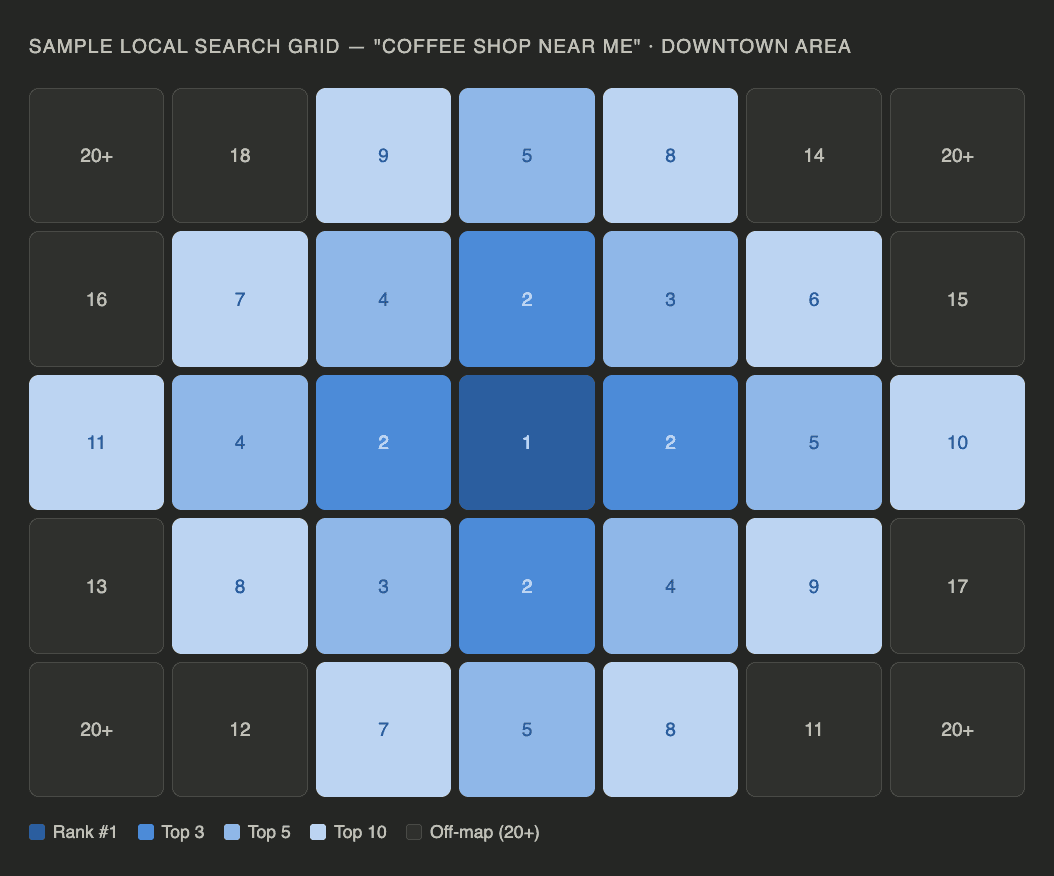
Google factors in how physically close your business is to the person searching. This is why two people searching the same term from different parts of a city can see completely different results. While you can't move your business, you can ensure your address is correctly and consistently listed everywhere online — your website, Google Business Profile, and all directories.
Your Service Area Pages
If you serve multiple towns or neighborhoods, having dedicated pages for each service area on your website can significantly expand your local ranking footprint. A roofing company that serves five nearby cities should have a separate, unique page for each city — not a generic page that vaguely says "we serve the greater metro area."
Local Link Building
Links from locally relevant websites carry extra weight in local search. Sponsoring a local sports team and getting a link from their website, being featured in a local newspaper, partnering with complementary local businesses for cross-promotion — these local links signal to Google that you are genuinely embedded in your community.
✦ ✦ ✦
Content: The Factor That Ties Everything Together
If there's one thing every credible SEO expert agrees on in 2026, it's this: content quality is the master factor. Every other signal — backlinks, reviews, technical SEO — is ultimately downstream of whether your content genuinely serves the person reading it. Google's Helpful Content system, introduced in recent years and continuously refined, specifically targets thin, generic, keyword-stuffed content and demotes it in rankings. It rewards content that demonstrates real experience, depth, and usefulness.
For a local business, this is actually an enormous competitive advantage. You have something that no outside blogger or content farm can replicate: genuine, first-hand knowledge of your trade, your local community, and your customers' specific problems. Use it.
Content Ideas for Local Businesses That Actually Rank
FAQ pages answering the exact questions your customers call about most often
"How to choose a [service provider]" guides written from your professional experience
Before-and-after project showcases with detailed descriptions and photos
Seasonal guides relevant to your trade (e.g., "How to prepare your home's plumbing for winter in [City]")
Honest pricing guides — customers search these constantly, and transparency builds trust
Neighborhood or area-specific content that demonstrates your local knowledge and community involvement
Behind-the-scenes content featuring your team, your process, and your values
Technical SEO: The Foundation Beneath Everything
Technical SEO refers to the behind-the-scenes elements that help Google find, crawl, and index your website correctly. You can have the best content in the world, but if Google can't properly access and read your site, none of it will rank. The good news for most local business owners is that technical SEO doesn't need to be overwhelming — you need to get the basics right, and then maintain them.
HTTPS Security
Google has officially confirmed that HTTPS (indicated by the padlock icon in your browser's address bar) is a ranking signal. If your website still says "http://" rather than "https://," fixing this should be your very first step. Your web host can typically enable an SSL certificate in minutes, often for free.
Page Speed and Core Web Vitals
Google measures specific page performance metrics called Core Web Vitals — how quickly your main content loads (LCP), how fast your page responds to interaction (INP), and how visually stable your page is while loading (CLS). A slow, janky website is not just frustrating for users; it actively hurts your rankings. Use Google's free PageSpeed Insights tool to see how your site scores and get specific recommendations.
Mobile-First Design
As mentioned, Google's mobile-first indexing means your mobile site is your primary site in Google's eyes. If you haven't updated your website in several years, there's a strong chance it isn't passing Google's mobile usability standards. A modern, responsive website design is no longer optional — it's table stakes for ranking in local search.
Structured Data / Schema Markup
Schema markup is a type of code you can add to your website that helps Google understand your business information more precisely — your hours, your service categories, your reviews, your physical location. Local businesses that use LocalBusiness schema markup give Google a direct, unambiguous signal about what they do and where they do it. This can also unlock enhanced search result features like star ratings and business hours appearing directly in the results.
"Most local businesses are competing on reputation and word-of-mouth. SEO is how you take that same reputation and make it visible to every person in your area who's searching online — 24 hours a day, 7 days a week."
Google's AI Systems and What They Mean for You
Google's ranking algorithm isn't just a list of rules — it's increasingly powered by sophisticated AI systems that understand language, intent, and context. Systems like RankBrain, BERT, and MUM allow Google to understand what a searcher means, not just what they literally typed. This shift has major practical implications for local businesses.
It means that keyword stuffing is dead. Writing "best plumber Chicago cheap plumber Chicago emergency plumber Chicago" ten times on your homepage will not help you rank — it will hurt you. What works is writing naturally and thoroughly about what you do, for whom, and why you're the best choice. Google's AI is good enough now to understand that a page comprehensively describing your plumbing services, your service area, your certifications, and your customer reviews is about emergency plumbing in Chicago — even if it doesn't repeat the exact phrase robotically.
It also means that topical authority matters more than ever. Rather than having one generic "services" page, businesses that build out rich, interconnected content about their area of expertise — multiple related pages that link to each other — signal to Google that they are a genuine authority in their field. A landscaping company with pages on lawn care, irrigation systems, seasonal planting, hardscaping, and local plant guides will consistently outrank a competitor with a single sparse "services" page.
Reviews: The Local Ranking Factor Most Businesses Ignore
If you're looking for one change you can make this week that will have a measurable impact on your local rankings within 30 days, focus on reviews. Google's local algorithm explicitly incorporates review signals: the total number of reviews, the average star rating, the recency of reviews, and even the content within reviews — when customers naturally mention your services or city in their review text, it reinforces those ranking signals.
The businesses that dominate local maps aren't always the oldest or the biggest. They're often the ones with a systematic approach to requesting reviews from every satisfied customer. A simple follow-up text or email after a completed job, with a direct link to your Google review page, can transform your review count from 20 to 200 within a year — and the difference that makes in your local rankings is dramatic.
Your Local Business SEO Quick-Start Checklist
Claim and fully complete your Google Business Profile — every field, every photo, every service
Ensure your NAP (Name, Address, Phone) is identical across your website, GBP, and all directories
Set up a simple review request system — a follow-up text after every completed job
Make sure your website loads in under 3 seconds on mobile (test at PageSpeed Insights)
Create a dedicated service page for every major service you offer
Create city or neighborhood pages if you serve multiple areas
Ensure your site uses HTTPS (padlock in the address bar)
List your business on Yelp, Bing Places, Apple Maps, and relevant industry directories
Write one piece of genuinely helpful content per month — an FAQ, a guide, a project showcase
Ask one complementary local business for a link to your site — or offer one in return
How Long Does SEO Take? Setting Realistic Expectations
This is the question every local business owner asks, and it deserves an honest answer. SEO is not paid advertising — you cannot simply invest $500 and appear at the top of results tomorrow. It's a long-term investment that compounds over time, and the timelines can feel frustrating if you don't understand what's happening under the hood.
For most local businesses starting from scratch or making significant improvements, here's a realistic timeline: within the first 1–3 months, Google will begin to recognize and crawl your improvements. Between months 3 and 6, you'll typically see movement in rankings for less competitive local keywords. By 6–12 months of consistent effort, you can expect meaningful improvements in your primary keywords and a measurable increase in organic traffic and local calls or visits. After 12 months, the momentum tends to compound — each piece of content, each new review, and each new backlink builds on what came before.
The businesses that win at local SEO are the ones that understand this timeline and commit to it. They publish helpful content consistently. They ask for reviews systematically. They keep their Google Business Profile updated. They don't chase shortcuts. They treat SEO the same way they treat reputation: something built slowly, maintained carefully, and incredibly valuable once established.
The Bottom Line for Local Businesses
Google's 200+ ranking factors are not a mystery designed to confuse and overwhelm local business owners. They are, at their core, a sophisticated attempt to answer one simple question: which business best serves this person's need? When you orient your entire online presence around genuinely serving your customers — with helpful content, a trustworthy website, consistent information, and an enviable collection of authentic reviews — you are, almost by definition, doing SEO correctly.
Your competitors in the paid advertising world have to keep paying to stay visible. Every dollar you invest in SEO builds an asset that continues to deliver customers long after the work is done. A page that ranks #1 for "emergency HVAC repair [your city]" doesn't turn off at midnight. It doesn't cost you per click. It works every hour of every day, finding customers at the exact moment they need exactly what you offer.
That's the real power of understanding and investing in Google's ranking factors. Not as a technical game to be gamed, but as a commitment to being the most visible, trustworthy, and genuinely helpful business in your local market.
Ready to Improve Your Local Rankings?
Every local business has unique opportunities hiding in its SEO. Get a free, no-obligation audit of your Google presence and find out exactly where to focus your efforts first.