GEO for Local Businesses: Southern California Optimization Strategies
Category
Content
Posted on
Updated

Author
Daria Nikolaeva
SEO & AI Search
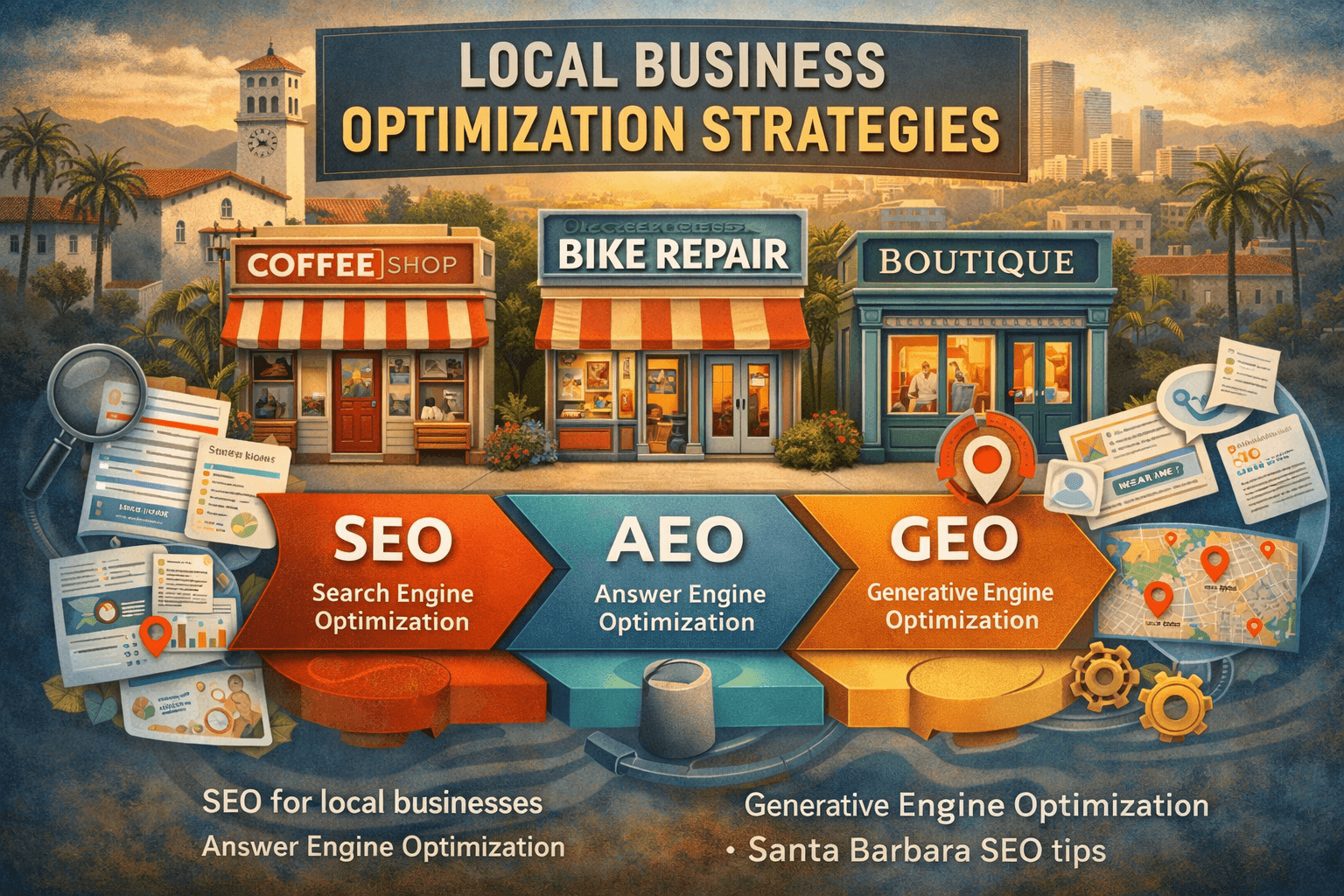
Table of Contents
1️⃣ SEO: The Classic Foundation
This guide covers GEO for local businesses alongside SEO and AEO — the three layers every Southern California business needs to get found online today. Local SEO is the foundation for any Southern California business that wants to get found by nearby customers. Search Engine Optimization, or SEO, is like the roots of a tree — it’s what keeps everything stable and growing over time. It’s the starting point for getting found online when people search for businesses like yours. Without solid SEO, the newer strategies we’ll talk about later won’t have much to stand on. Whether you run a small business in Santa Barbara or a growing brand across Southern California, these three layers apply to you.
Think about it: when someone in your town types “best plumber near me” into Google, you want your business to show up. SEO makes that happen by matching your website to what people are looking for.
Keyword Mapping: Speak Your Customers’ Language
Start with keyword mapping, which simply means figuring out the exact words and phrases your potential customers use when searching. It’s not about guessing — it’s about listening to real searches.
For a local bakery in Santa Barbara, don’t just optimize for “bakery.” Map out specifics like “gluten-free cupcakes santa barbara,” “wedding cakes near State Street,” or “best coffee and pastry downtown SB.” These are longer, more detailed phrases that people actually type.
How do you find them? Use free tools like Google’s Keyword Planner or just type your main service into Google and see the suggestions that pop up. List 5-10 phrases per page on your site. Then, weave them naturally into your headlines, first paragraphs, and image descriptions.
Take Maria’s Taqueria, a small spot in Santa Barbara. By mapping keywords like “authentic fish tacos Carpinteria” and placing them in menu pages and blog posts about local fishing spots, they started showing up in searches from beachgoers. Steady tweaks like this brought 30% more foot traffic in six months — no ads needed.
Authority Building: Become the Trusted Name
Next, build authority, which is about proving to search engines that you’re reliable. It’s like getting recommendations from neighbors — the more trusted voices point to you, the more people believe in your business.
Earn this through quality links from local sites. Partner with a nearby chamber of commerce for a guest post, get mentioned in a Santa Barbara lifestyle blog, or sponsor a community event and link back to your site. Customer reviews on google business Profile count hugely here — aim for 50+ honest ones.
Before you list anywhere, make sure your NAP — name, address, and phone number — is identical everywhere. Inconsistent NAP is one of the most common reasons local businesses drop in rankings. Local directories like Yelp, Yellow Pages, and even niche ones for your industry (e.g., HomeAdvisor for contractors) are goldmines. Claim and optimize every listing with your address, photos, and services.
For example, a Santa Barbara bike repair shop gained authority by writing simple guides like “How to Fix a Flat Tire on Stearns Wharf Rides.” Local blogs linked to it, and suddenly they ranked for “bike repair Santa Barbara beach.” Authority snowballs: one good link leads to more visibility, more customers, more reviews.
Technical Health: Make Your Site Work Smoothly
Finally, technical health ensures your site loads fast and works on phones — because 60% of local searches happen on mobile. Slow sites or broken pages push you down the rankings.
Check basics: Use Google’s PageSpeed Insights (free) to test speed. Compress images, remove clutter, and enable fast hosting. Ensure your site is “mobile-responsive” — pinch and zoom on your phone to confirm.
For local businesses, add your address to every page with a Google Map embed. Use structured data — also called schema markup — to highlight your hours, location, and reviews. This simple code tells Google exactly what your business offers and makes you pop in search results.
A Santa Barbara florist fixed their slow image-heavy site and added location schema. Within weeks, they appeared in “flowers near me” maps, doubling online orders during peak seasons like Mother’s Day.
SEO takes time — 3-6 months for results — but it drives free, ongoing traffic. It’s the base layer that supports everything else.
2️⃣ AEO: Answer Engine Optimization
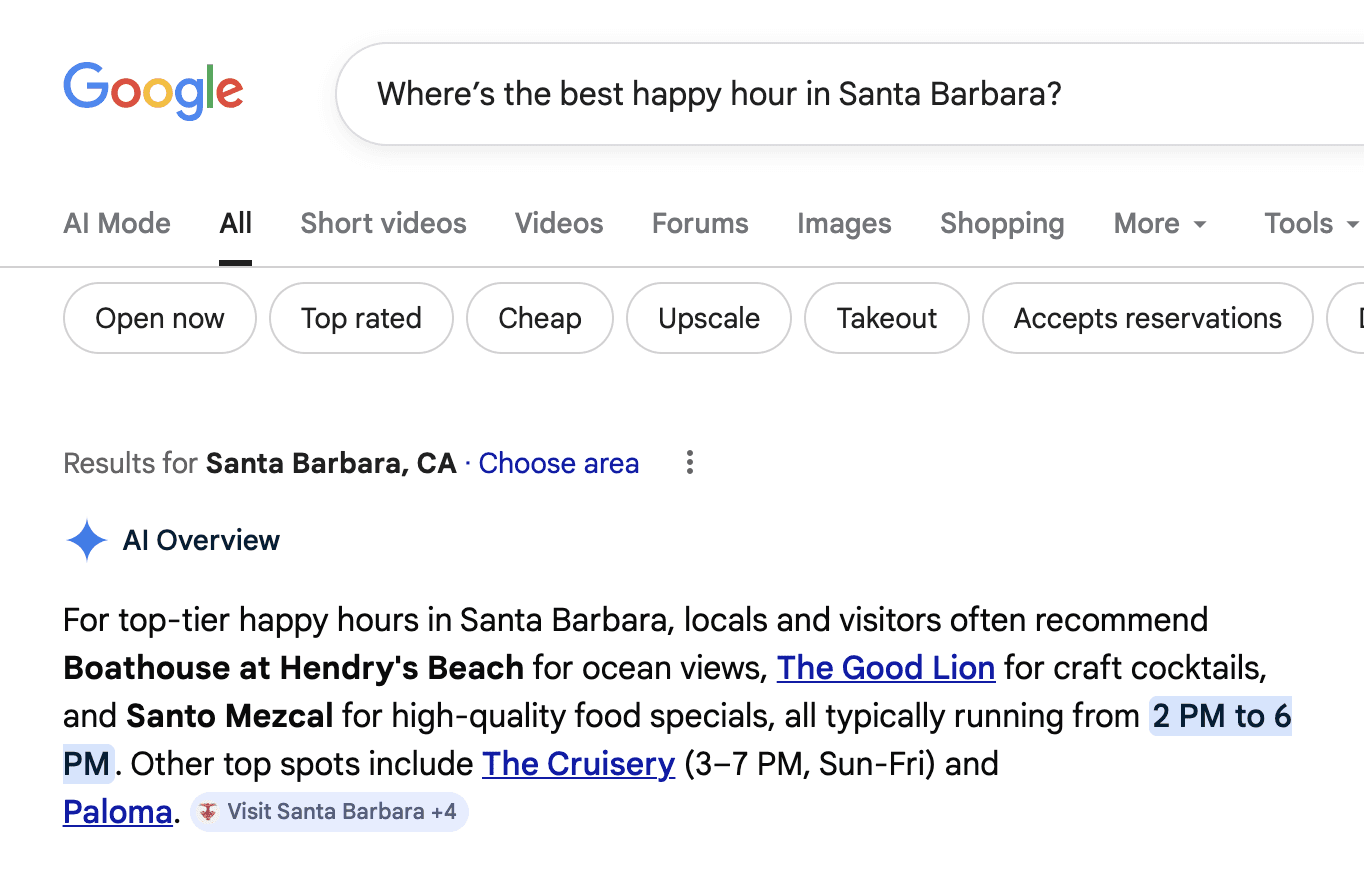
Now that you have SEO basics in place, layer on Answer Engine Optimization (AEO). This is about making your content so clear and direct that AI tools like Siri, Alexa, or Google’s AI Overviews pull it as the instant answer. People don’t always click anymore — they want answers right away.
Imagine someone asks their phone, “Where’s the best happy hour in santa barbara?” AEO positions your bar’s details as the top response, shown before any links.
Featured Snippets: Grab the Spotlight Box
Featured snippets are those handy boxes at the top of Google results — a quick summary pulled from your site. They get 8-10% of clicks but huge visibility.
To win them, structure content for easy extraction. Use short paragraphs (2-3 sentences), numbered lists, and tables. Answer questions directly: Start with “The best happy hour in Santa Barbara is at Joe’s Bar on State Street, with $5 margaritas from 4-7 PM daily.”
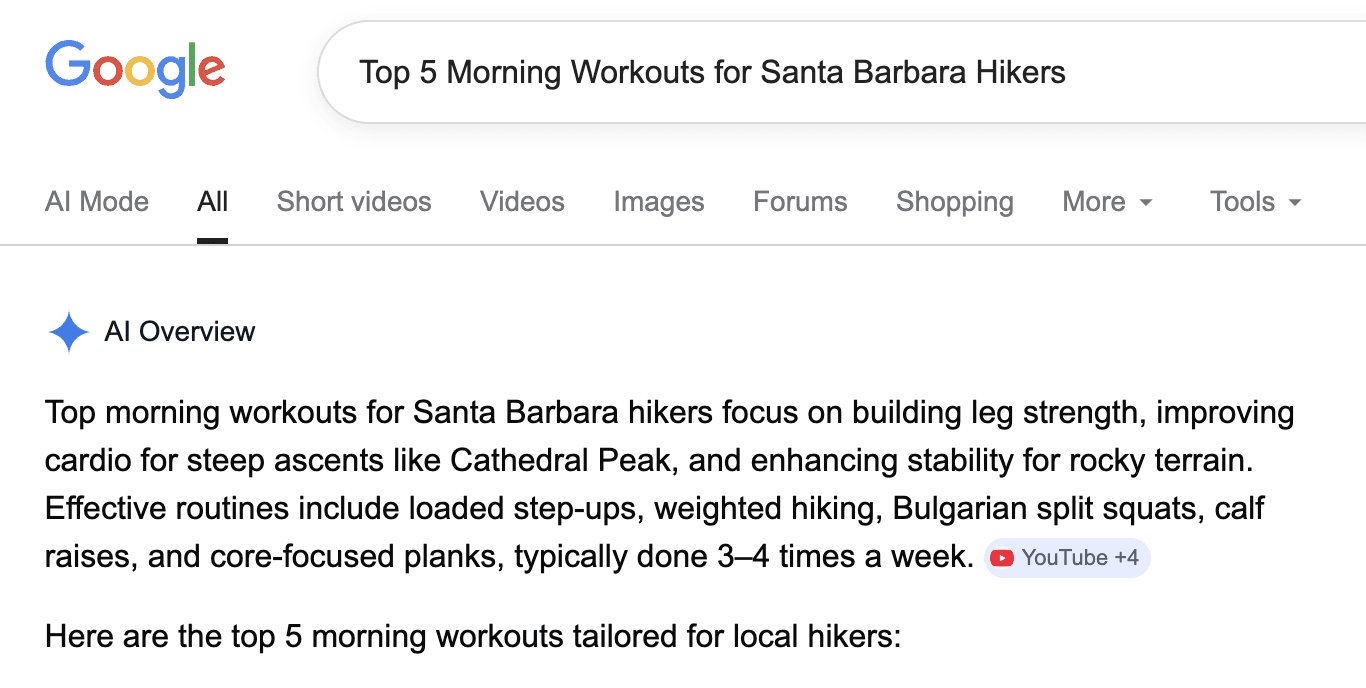
For a local gym, create a page like “Top 5 Morning Workouts for Santa Barbara Hikers.” Google loves pulling the list as a snippet. A real gym did this and saw membership inquiries jump 25% from voice searches.
FAQ Schema: Help AI Understand You
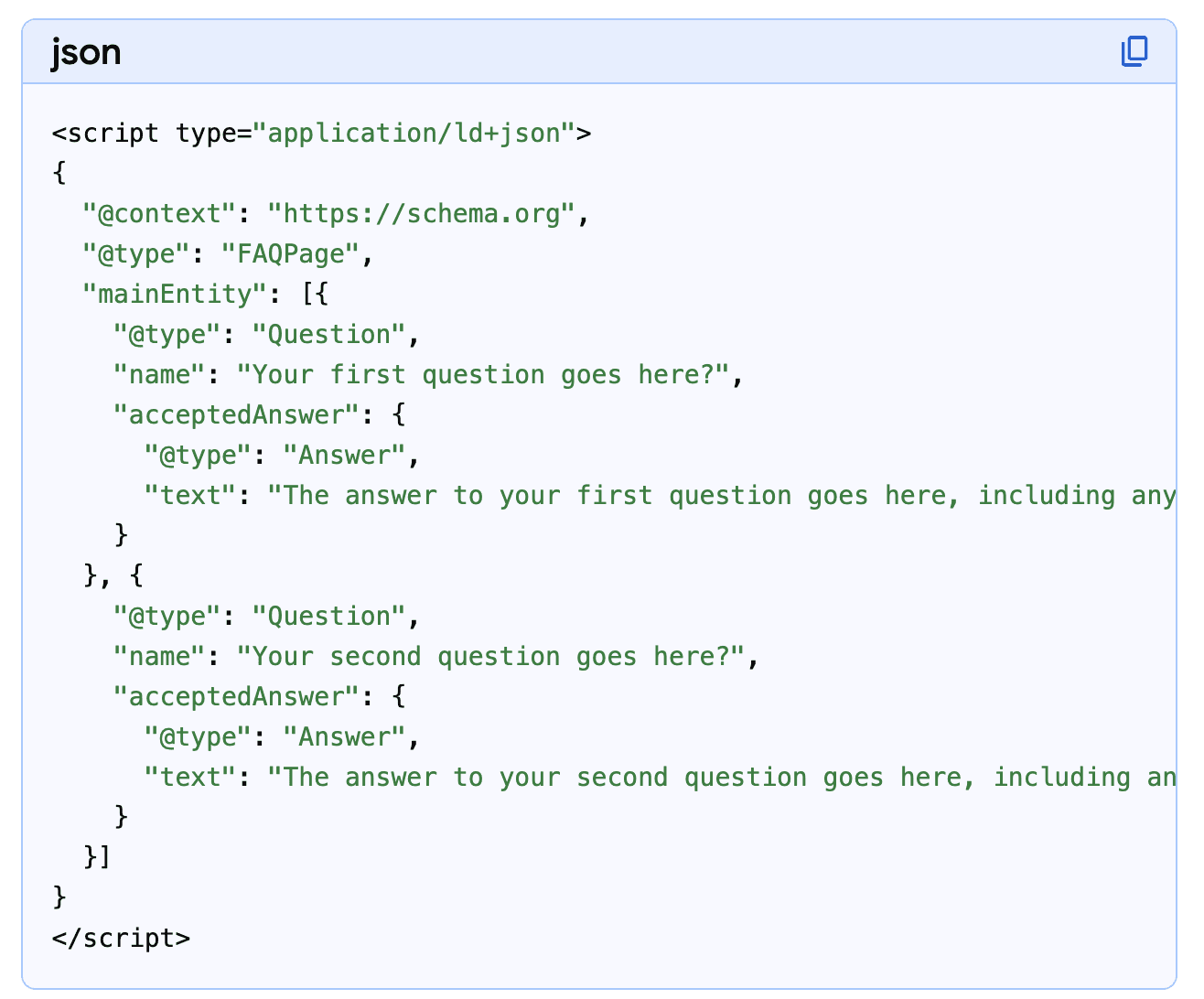
FAQ schema is free code you add to your site (plugins like Yoast make it easy) that tags questions and answers. It tells search engines, “This is FAQ content — use it for voice answers.”
List 5-10 common questions: “How much does a Santa Barbara house cleaning cost?” Answer plainly: “Average rates are $100-150 for a 3-bedroom home, depending on deep clean needs.”
A cleaning service in our area added FAQ schema to their site. Soon, their answers appeared in Google’s “People Also Ask” boxes and voice results, bringing calls from busy professionals.
Clear, Concise Answers: Write Like You Talk
Keep language simple — no fluff. Use short sentences, active voice, and bullet points. Think: How would you explain to a friend rushing out the door?
For a coffee shop: Instead of a wall of text, say: “Our lattes use organic beans from local roasters. Sizes: 12oz ($4.50), 16oz ($5.25). Dairy-free milks available.”
This style feeds AI systems perfectly. A Santa Barbara bookstore optimized their “Book Recommendations for Beach Reads” page this way. Their concise lists now appear in AI chat responses, driving curious readers in-store.
AEO shines for local queries — it’s quick wins on mobile and voice, bridging to the next layer.
3️⃣ GEO: Generative Engine Optimization
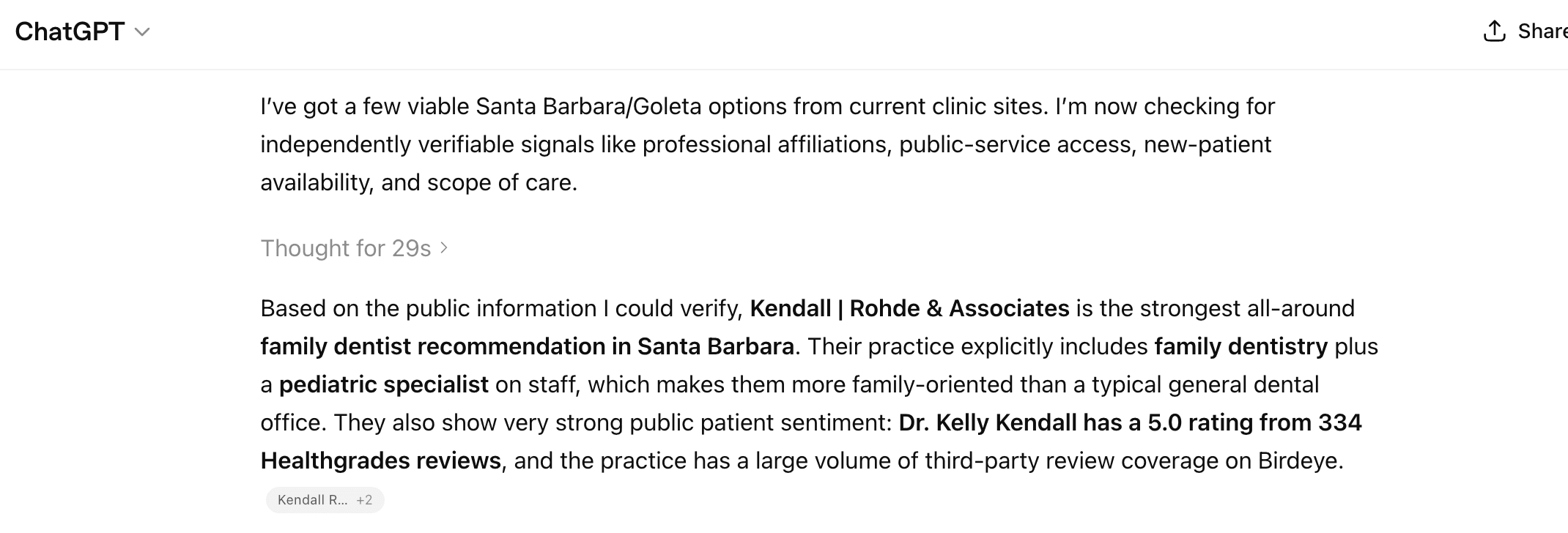
Generative Engine Optimization (GEO) is the cutting-edge layer for AI-powered search tools like ChatGPT and Perplexity. Here, your content doesn’t just rank — it becomes the quoted source in AI-generated answers. This is huge for local businesses, as AI chats often recommend nearby options.
GEO ensures that when someone asks an AI, “Recommend a family dentist in Santa Barbara,” your clinic is cited with reasons why.
Clean, Logical Structure: Guide the AI
AI parses content like a librarian scanning shelves. Use clear headings (H1, H2), short paragraphs, and logical flow: Problem → Solution → Your Business.
Start pages with a bold summary: “Santa Barbara Family Dentistry: Gentle care for kids and adults, open weekends, 4.9-star reviews.” Follow with sections on services, testimonials, and unique perks like “beach-themed waiting room.”
A local dentist structured their site this way. Now, AIs cite them for “kid-friendly dentists SB,” pulling in families who trust the AI’s pick.
Credible, Authoritative Sources: Back Up Claims
AI favors trustworthy info. Link to local news, studies, or your Google reviews. Mention awards: “Voted Best Auto Repair in Santa Barbara Independent 2025.”
For a repair shop: “Our ASE-certified mechanics use OEM parts, as recommended by the California Auto Association.” Embed review widgets and cite sources inline.
This builds “platform trust.” A Santa Barbara restaurant added links to local food critic reviews and farm supplier pages. AIs started naming them in “farm-to-table spots SB” responses, boosting reservations 40%.
Platform Trust: Strengthen Your Profiles
Tie everything to trusted profiles. Optimize Google Business, Yelp, and TripAdvisor with matching info, fresh photos, and replies to reviews.
Post weekly updates: “New summer menu at our Santa Barbara café — try the avocado toast!” Consistent activity signals freshness to AI.
A café chainlet did this across platforms. Their cohesive presence made them the go-to in AI answers for “pet-friendly brunch SB,” turning browsers into loyal customers.
Setting clear geo targets in your content — mentioning your city, neighborhood, and service area — helps AI tools know exactly which customers to recommend you to. GEO future-proofs you — as AI search grows (projected 50% of queries by 2027), you’re the source.
Why Stack All Three Layers?
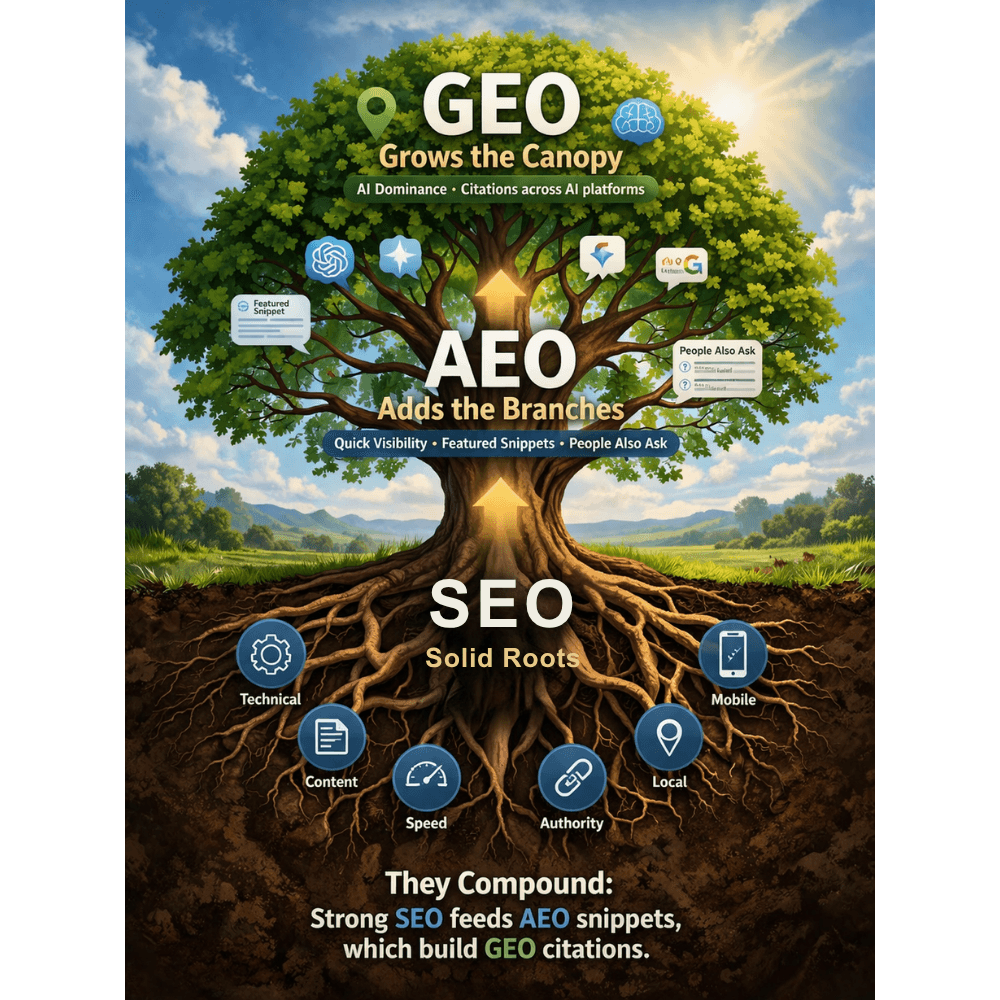
SEO gives roots, AEO adds branches for quick visibility, GEO grows the canopy for AI dominance. They compound: Strong SEO feeds AEO snippets, which build GEO citations.
For Santa Barbara businesses, start with a content audit: Pick 10 key pages, map keywords, simplify answers, add schema and sources. Tools like Google Analytics track progress — watch organic traffic climb.
Case study: A fictional-but-realistic Santa Barbara real estate agent stacked these. SEO mapped “homes under 1M near Butterfly Beach.” AEO added FAQ snippets like “Average closing costs in SB?” GEO structured authoritative guides with local market data. Result: Top rankings, AI mentions, 50% lead growth in a year.
Action Steps for Your Business
Audit your site: Spend one day checking speed, keywords, and mobile view.
Create one AEO page: Pick a high-search question and answer it snippet-style.
Build GEO trust: Update profiles, add 5 credible links per page.
Measure monthly: Use free Google tools to track rankings and traffic.
Iterate: Refresh content quarterly with local events or trends.
Local businesses thrive by adapting now. Stack SEO, AEO, GEO — and watch steady customers roll in, from Google to AI chats.


