Why Your Business Isn't Showing Up on Google Maps — and What to Do About It
Category
Content
Posted on
Updated

Author
Daria Nikolaeva
SEO & AI Search
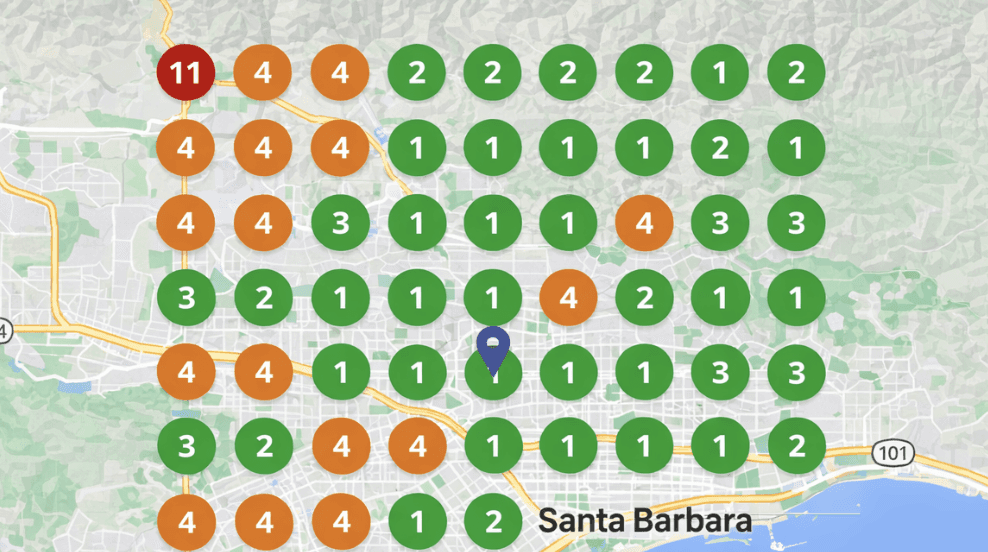
Table of Contents
Most local business owners assume they're ranking well on Google Maps. Most of them are wrong. Here's why visibility varies block by block — and how to finally see the full picture.
You claimed your Google Business Profile. You asked customers for reviews. You've kept your hours updated and added photos. So why is your competitor across the street showing up first — and sometimes you're not showing up at all?
The uncomfortable truth: Google Maps rankings are not uniform. Where you appear in local search results depends heavily on where the searcher is standing. A customer two blocks north of you might see you in the top three. Someone six blocks south might not see you on the first page at all.
That invisible geography is costing you customers every day.
The map pack problem nobody talks about
When someone searches "dentist near me" or "best pizza in Santa Barbara," Google returns what's called the Local Pack — that cluster of three business listings pinned to a map at the top of results. It's prime real estate. Studies consistently show that the majority of clicks go to these three slots.
But here's what most business owners don't realize: that Local Pack is dynamically generated based on the searcher's physical location. Google tries to surface the most relevant and nearby option for each person. So your ranking isn't a single number — it's a moving target across your entire service area.
"Checking your own Google Maps ranking by searching from your desk gives you exactly one data point. Your customers are spread across an entire city."
76% of "near me" mobile searches result in a store visit within 24 hours
#1–3 Local Pack positions capture the vast majority of local search clicks
~1 mi How far your ranking can shift dramatically from your business address
What actually drives your Google Maps ranking
Google uses three core pillars to determine local rankings. Understanding them is the first step to improving them.
✦ Relevance — Does your Business Profile match what the customer is searching for? This includes your business category, the services you list, the keywords in your description, how well your profile is filled out, and consistent posting of updates.
✦ Distance — How close is your business to the searcher (or the location they've specified)? This is why rankings shift so dramatically across a city — you're literally competing in a different race depending on where the customer is.
✦ Prominence — How well-known and trusted is your business, both online and offline? Reviews, ratings, backlinks, citations, and overall web presence all feed into this score.
The challenge is that you can optimize all three — but you can't optimize what you can't see. That's where most local businesses are flying blind. Start with the basics — make sure your Google Business Profile is fully optimized before worrying about your grid position.
See where you actually rank — not where you think you rank
This is exactly the problem Local Search Grid was built to solve. Instead of giving you a single ranking number, Local Search Grid lays out your Google Maps positions across a geographic grid — showing you exactly where you're strong, where you're invisible, and where your competitors are eating your lunch.
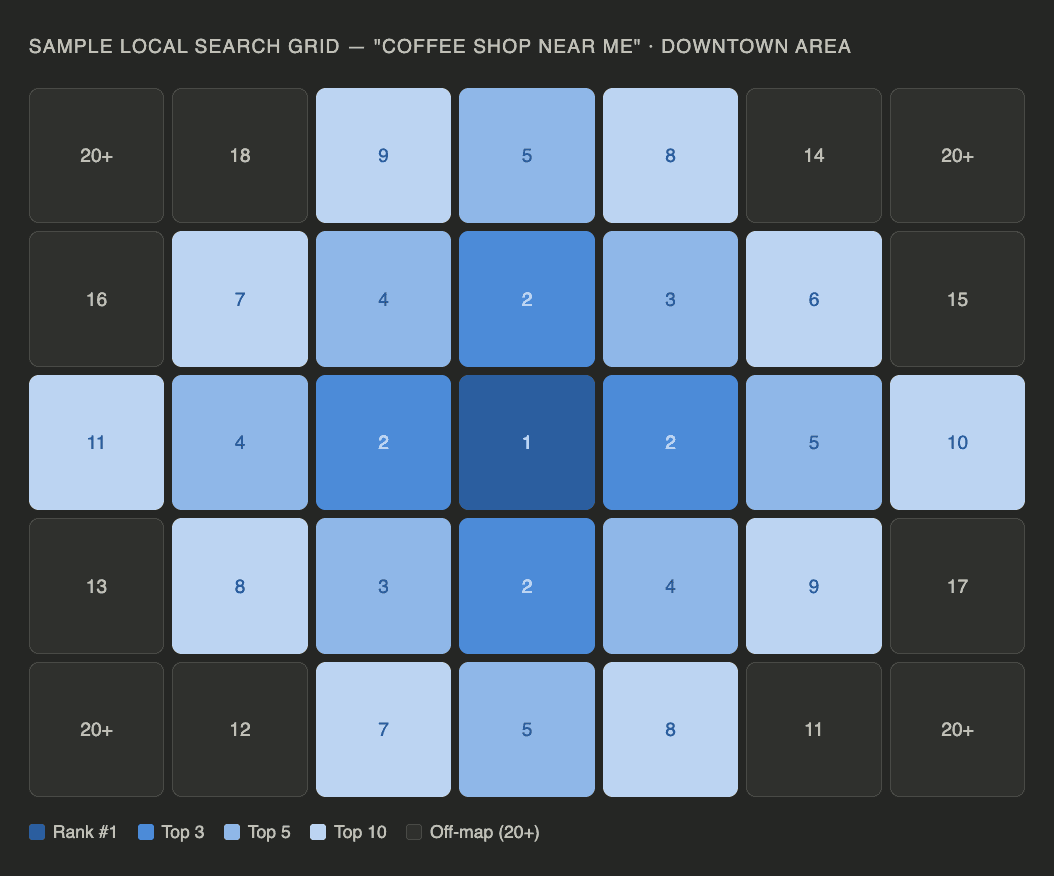
You get a heat map of your entire service area. A dark blue cell near your address means you're showing up in the top results. A faded cell eight blocks away means a potential customer searching from there will never find you. That gap is your opportunity.
✓ See your ranking at every point across your target service area — not just from your front door
✓ Identify the exact geographic zones where competitors outrank you
✓ Track changes over time as you make SEO improvements
✓ Run grids for any keyword — from your primary service to every specialty you offer
✓ Benchmark against specific competitors to see who's winning where — and why
Turning insight into action
Knowing where you rank is powerful. Knowing what to do about it is where Local Search Grid goes further. Once you can see the weak spots on your grid, the path forward becomes clearer:
Expand your geographic signals. If you're weak in the northern half of your city, look at whether you have any citations, reviews, or web mentions tied to that area. Local relevance signals can help Google understand your service area more completely.
Double down on reviews — strategically. Reviews are one of the strongest prominence signals Google uses. Encourage happy customers to mention neighborhood or area-specific details in their reviews. "Best plumber in Westside" carries more geographic weight than a generic five-star.
Audit your competitors' weak spots. The grid doesn't just show your rankings — it shows where competitors are vulnerable. If a rival is strong near their address but fades fast, that's a gap you can capture with targeted optimization.
Track every change you make. Run a new grid after each significant update to your Business Profile, a review push, or a new citation campaign. Local SEO moves slowly, but the grid makes progress visible.
"The businesses winning at local SEO aren't just optimized — they're informed. They know their blind spots before their customers find them first."
The bottom line
Google Maps is one of the most valuable marketing channels available to a local business — and one of the most misunderstood. Your ranking isn't a fixed number. It's a living landscape that shifts with every block, every keyword, every competitor move.
Local Search Grid gives you the map. What you do with it is up to you — but at least you'll finally know where you stand.
Let’s talk about your next step.
Schedule a free 15-minute consultation with SOURCEsem. Tell us about your business, ask your questions, and get clarity on where to focus next.