
How AI Is Changing the Marketing Industry (and What Comes Next)
Category
Content
Posted on
Updated

Author
Daria Nikolaeva
SEO & AI Search
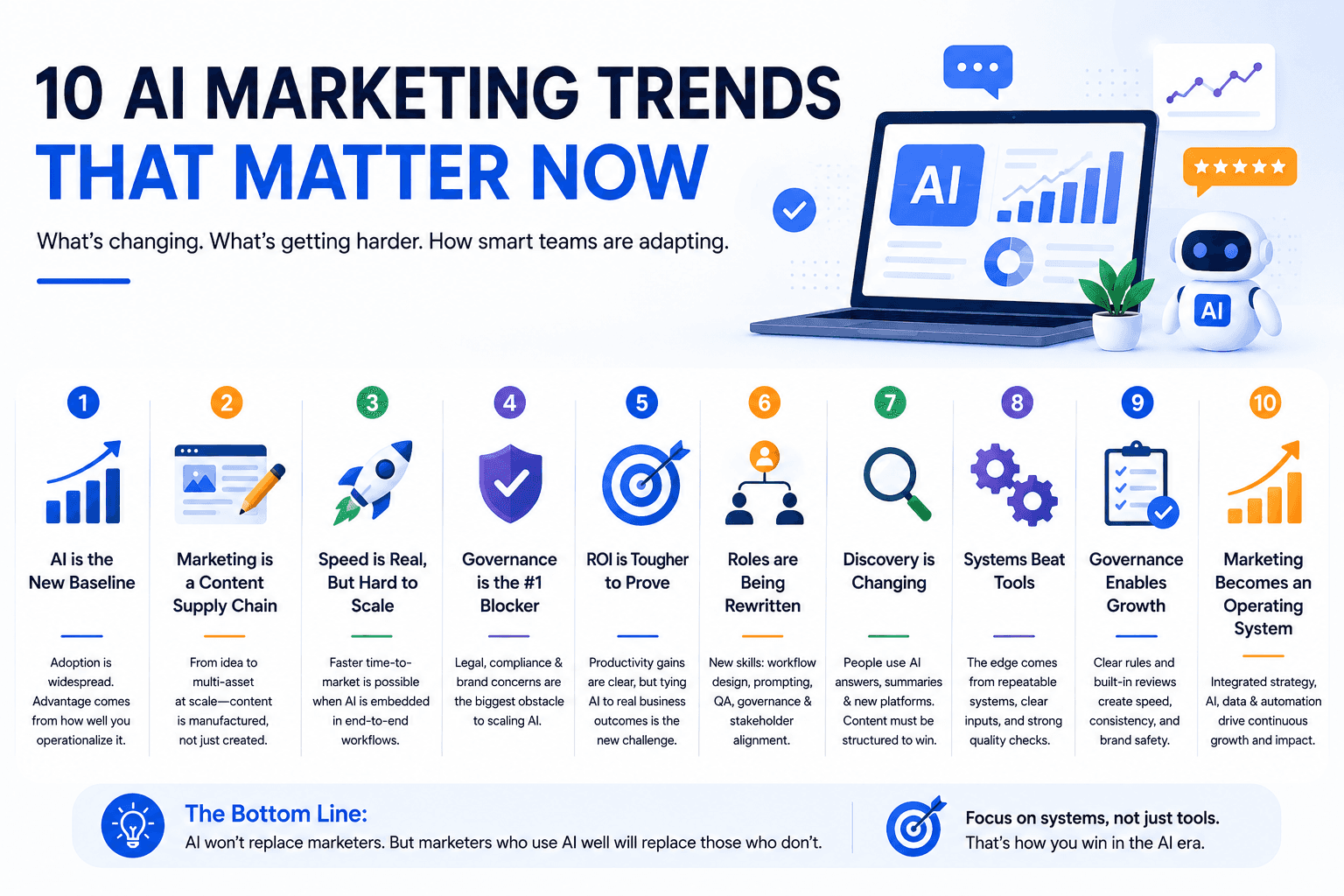
Table of Contents
Below is a practical, non-hype look at what’s changing, what’s getting harder, and how modern marketing teams are adapting—grounded in Jasper’s survey data (1,400 marketers) plus additional industry research.
1) AI adoption is now the baseline, not the differentiator
Jasper’s research indicates AI use has crossed the “standard operating procedure” threshold: 91% of marketing teams report using AI, a steep rise compared to the prior year’s benchmark in the report.
That matches what many enterprise trend reports have been signaling: adoption is widespread, and advantage now comes from how well you operationalize AI—not whether you have access to it. McKinsey similarly emphasizes that capturing AI value correlates with organizational practices like operating model, talent, and scaling—not simply experimentation.
What this means: “We use AI” is no longer a differentiator. “We use AI with reliable quality, measurable outcomes, and low risk” is.
2) Marketing is moving from “campaign craft” to “content supply chain”
One of Jasper’s clearest findings is that AI is being applied most heavily where marketing feels constant pressure: content and creative production.
Common AI use cases in the Jasper study include:
idea generation
single-asset creation
multi-asset generation (moving from one-off outputs to coordinated sets of deliverables)
SEO / AI search optimization (discoverability across traditional and AI-driven surfaces)
The big operational shift is this: marketing is increasingly expected to behavioral system—with repeatable workflows, QA gates, and throughput goals—rather than a series of bespoke creative projects.
New reality: content isn’t just “made,” it’s manufactured—and the winners will be the teams who can scale without becoming spammy, off-brand, or risky.
3) Speed is real… but “speed at scale” is still elusive
AI is improving speed in meaningful ways. Jasper reports that accelerating time-to-market is a top realized benefit, alongside scaling high-quality content and improving productivity.
But Jasper also highlights a core bottleneck: many teams still take months to plan and launch a full campaign, and true compression only happens when AI is embedded in end-to-end workflows—from planning through review and activation.
Translation: buying AI tools doesn’t automatically create speed. Your operating model does — meaning the way your team is structured and how work moves from idea → creation → review → launch.
4) Governance has become the #1 blocker (not talent, not budget)
This is one of the most important “AI-era marketing” takeaways from Jasper:
As AI scales, the main constraint is no longer access, expertise, or leadership buy-in. It’s governance—legal, compliance, and brand review processes. Jasper notes governance concerns surged dramatically year over year and became the leading blocker to scaling AI.
That aligns with broader industry concern about responsible AI and brand safety—because once AI is used at scale, the risks scale too. A single mistake (an incorrect claim, a misleading statistic, an off-brand tone, a biased message, or the accidental use of restricted/owned content) can spread across dozens of assets and channels before anyone catches it. That’s why governance is becoming the real bottleneck: legal, compliance, and brand teams aren’t trying to slow marketing down—they’re trying to prevent reputational damage, regulatory issues, and costly rework. In other words, AI doesn’t remove the need for review; it increases the need for repeatable, built-in review rules so speed doesn’t come at the expense of trust.
5) Proving ROI is getting tougher—even when AI helps
AI can clearly boost productivity, but many teams struggle to tie that lift to business outcomes. The challenge isn’t that AI isn’t working—it’s that leadership expectations have shifted. “We saved time” isn’t enough anymore. Teams are being asked to connect AI to measurable results like lead quality, conversion rate, pipeline velocity, and revenue influence. If measurement stays stuck at output volume (more blogs, more ads), the ROI story stays weak.
6) Marketing roles are being rewritten around AI
AI isn’t replacing entire marketing teams, but it is changing what those teams do. New responsibilities are showing up across roles: building workflows, setting brand rules for AI, improving prompts and templates, managing QA, and coordinating with legal/compliance. The most valuable marketers are becoming part strategist, part operator—people who can use AI to scale work while keeping standards high.
7) Discovery is changing, so the distribution strategy has to change too
AI isn’t only impacting how content gets created—it’s changing how people find information. Search behavior is shifting toward ai answers, summaries, and conversational discovery. That means marketing has to adapt: content must be structured, credible, and easy for systems (and humans) to trust. Visibility is no longer just “rank on Google”—it’s “be cited, referenced, and surfaced across multiple discovery surfaces.”
For a full breakdown of how search itself is changing and what it means for your visibility, that guide covers GEO, LLMO, and the shift from rankings to real answers.
For the practical SEO implications specifically, what this means for your SEO strategy answers the most common questions about keywords, rankings, and content in the AI era.
8) The advantage is moving from tools to systems
The gap between average and high-performing teams isn’t the AI tool stack. It’s the system around it: clear inputs, defined workflows, quality checks, and consistent brand rules. Teams that treat AI like a repeatable production process (not a random creativity button) ship faster, make fewer mistakes, and get more predictable results.
If you're looking for free AI tools to put this into practice, that list covers the best no-cost options for SEO, content, and monitoring
9) Governance becomes a growth lever—not just a blocker
Governance sounds like red tape, but in the AI era it can actually enable speed. When teams define what’s allowed (claims, tone, sources, compliance rules) and build those rules into workflows, approvals get easier—not harder. The goal isn’t “more reviews.” The goal is fewer surprises, fewer rewrites, and safer scaling.
10) What’s next: marketing becomes an operating system
Marketing is moving toward an “ops” model—where success depends on process design, quality control, and measurement, not just creative output. AI accelerates production, but the teams who win will be the ones who build dependable engines: clearer strategy inputs, smarter workflows, stronger distribution, and tighter feedback loops.


